Axis
Completed in 2026 at the age of 19
Overview
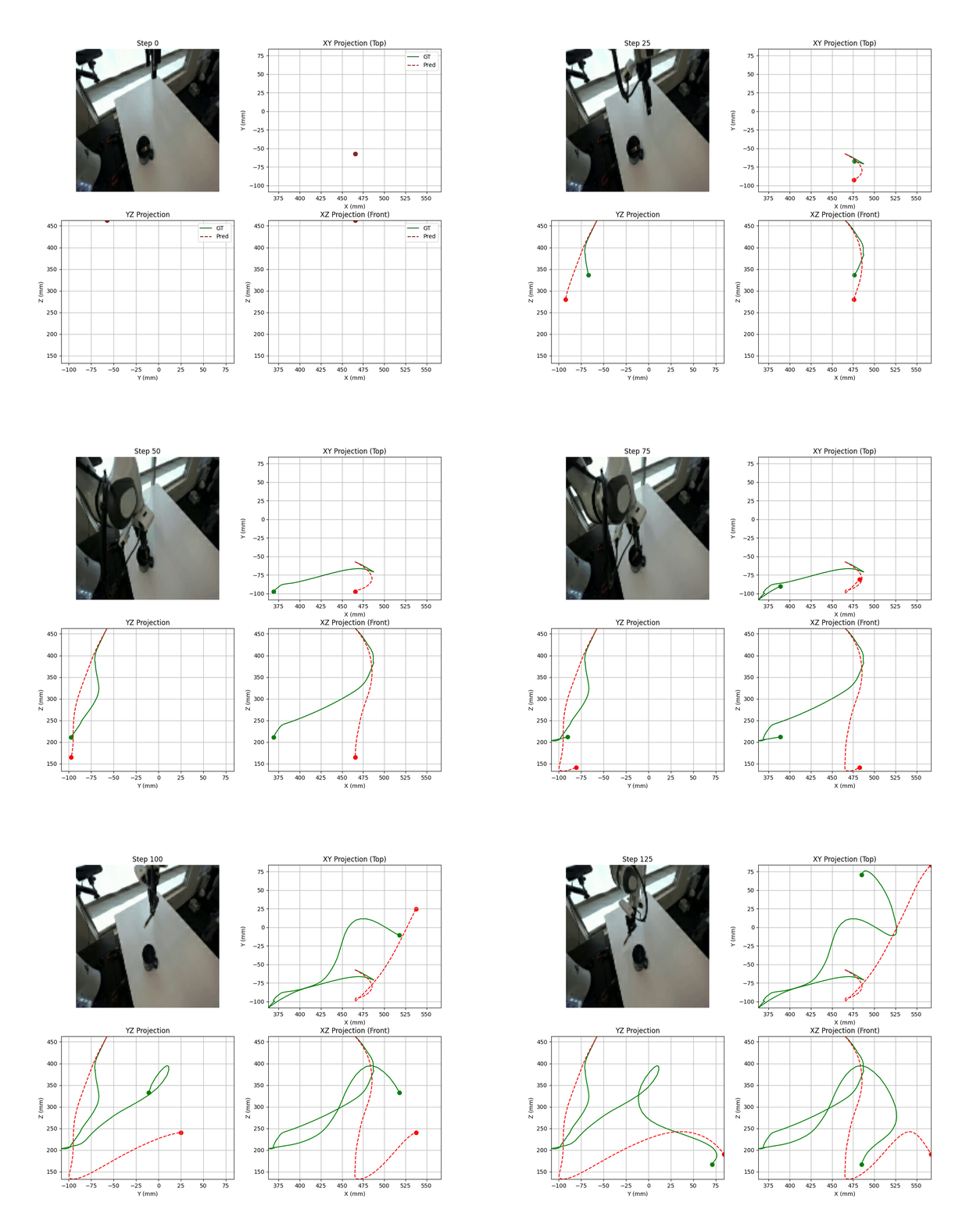
Axis is a PyTorch transformer-based robot learning framework designed for end-effector control using SE(3) Lie group representations. By treating robot control as a sequence modeling problem, Axis learns from diverse datasets like DROID and Fractal via imitation learning to predict SE(3) twist actions.

Interactive Architecture Diagram
Hover over the components to explore the inner workings and tensor shapes of the Axis V2 model.
Vision
Image Window
Vision Input & Encoder
Shape: (B, W, 3, 224, 224)
Encoder: DINOv2 ViT-S/14
Encodes multi-camera visual input into dense 768D representations per frame.
Proprioception
13D SE(3) State
Proprioceptive State
Shape: (B, W, 13)
Contains flattened rotation matrix (9D), translation (3D), and gripper state (1D).
Mapped to 128D via an MLP.
Goal
Semantic Embedding
Goal Embedding
Shape: (B, 38)
Structured semantic goal vector including 13D start and end poses. Mapped to 128D via an MLP.
Token Construction
Per-Frame Concatenation
Tokenization
Shape: (B, W, 1024)
Concatenates Proprio (128D) + Vision (768D) + Goal (128D) into a single 1024D token per timestep.
Axis Transformer
8 Layers, 16 Heads, RoPE
Transformer Backbone
Shape: (B, W, 1024)
Uses Rotary Position Embeddings (RoPE) for improved sequence modeling across the temporal window `W`.
Last Token Extraction
Causal Bottleneck
Bottleneck
Shape: (1, 1024)
Extracts only the final output token output_tokens[:, -1, :] for future prediction.
Action Decoder
Future Trajectory
SE(3) Twist Actions
Shape: (B, ChunkSize, 7)
Predicts a sequence of Lie algebra twists [ω, v, gripper] using an Action Chunking approach.
Confidence Decoder
Reliability Score
Self-Supervised Confidence
Shape: (B, 1)
A simple MLP prediction trained to estimate the model's own accuracy (action loss) for the current step.
Key Features
- SE(3) Twists: Actions are geometrically consistent, represented as 7D Lie algebra twists
[ω, v, gripper]via PyPose. - Action Chunking: Predicts
Wfuture actions in parallel, bypassing the need for autoregressive rollout. - Endpoint Chordal Loss: Utilizes a trig-free Frobenius norm for task-oriented SE(3) loss optimization.
- Temporal Ensembling: Overlapping chunk averaging yields smooth and robust action output.
- Self-Supervised Confidence: The model actively learns to predict its own accuracy to provide a confidence signal.